Sachaqa Art Residency Amazon Peru 2017 - 18.

Sachaqa My home for the next few months.
In December 2017, I left a grey and cold London, England to travel to Peru. My destination Sachaqa Art Centre in the village of San Roque de Cumbaza, San Martin region situated in the lush Amazon jungle where I would be based for the next four months. I had visited Sachaqa, which means spirit of the forest in Quechua, five years previously. Then I learnt about locally sourced natural pigments and dyes made from plants and fruit as well as the art and craft of the Quechua, the indigenous people of the area. My focus this time was to create an icon of the village’s patron San Roque or Saint Roch. The Directors of Sachaqa had re-started the patronal festival two years previously and it had brought the community together including the three local churches, who normally had little contact with each other even though all are situated in the same plaza. People from surrounding villages also travelled and took part in the three-day festival. The enthusiasm and energy created by the festivities was the inspiration for my return to paint an icon of Saint Roch.

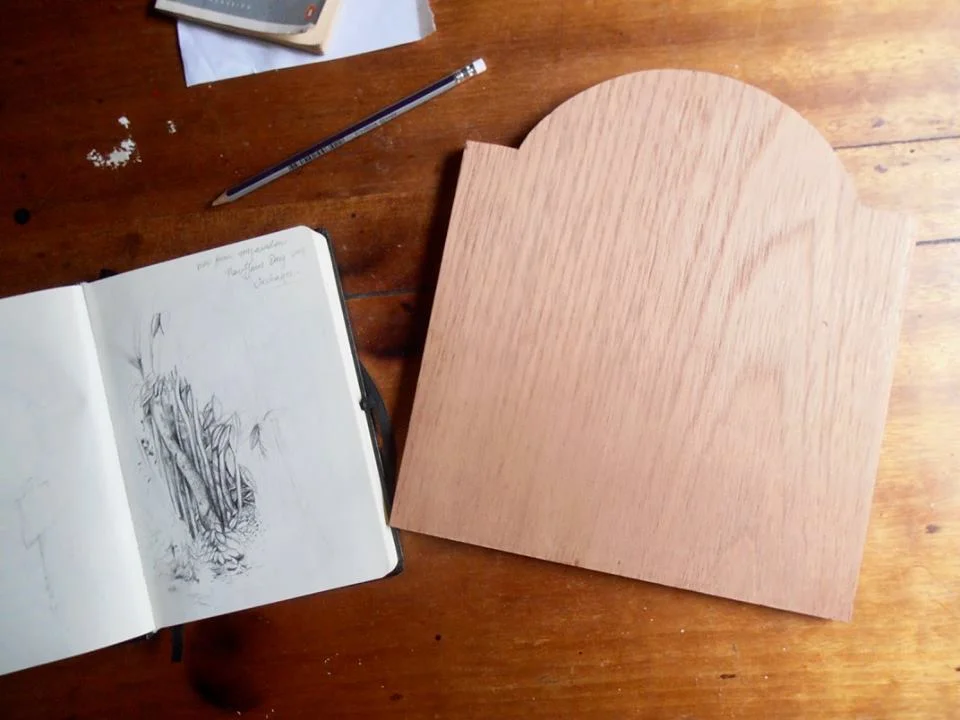
Study from Lamas.

Study from Lamas.
With generous support from the Bishop Radford Trust I was able to travel to Peru and work with local people in San Roque and surrounding villages, researching the story of why the village was named after the French saint and how the people related to him today. Saint Roch, or Rocco, lived in the 14th century. He is a Catholic saint, a confessor whose death is commemorated on 16 August and 9 September (in Italy) but celebrated on the 23rd July in the Amazon village. He is specially invoked against the plague as well as being patron saint of dogs, falsely accused people, bachelors, and several other things.
To start my research I travelled to Lamas a small town over an hour’s drive from San Roque de Cumbaza, where there is a large Quechuan community. Every Sunday in the lower plaza elders from the town gather in traditional dress to perform a ritual where dancing arm in arm they move rhythmically in a group. I was transfixed by this simple and yet powerful event. The women seemed especially prominent, and expressed a strength and steely determination. Like many people in Peru today the majority of the Quechua follow the Catholic faith but they have also weaved their own spiritual and cultural beliefs into Christianity. A strong and resilient people I left Lamas with many ideas for the icon.
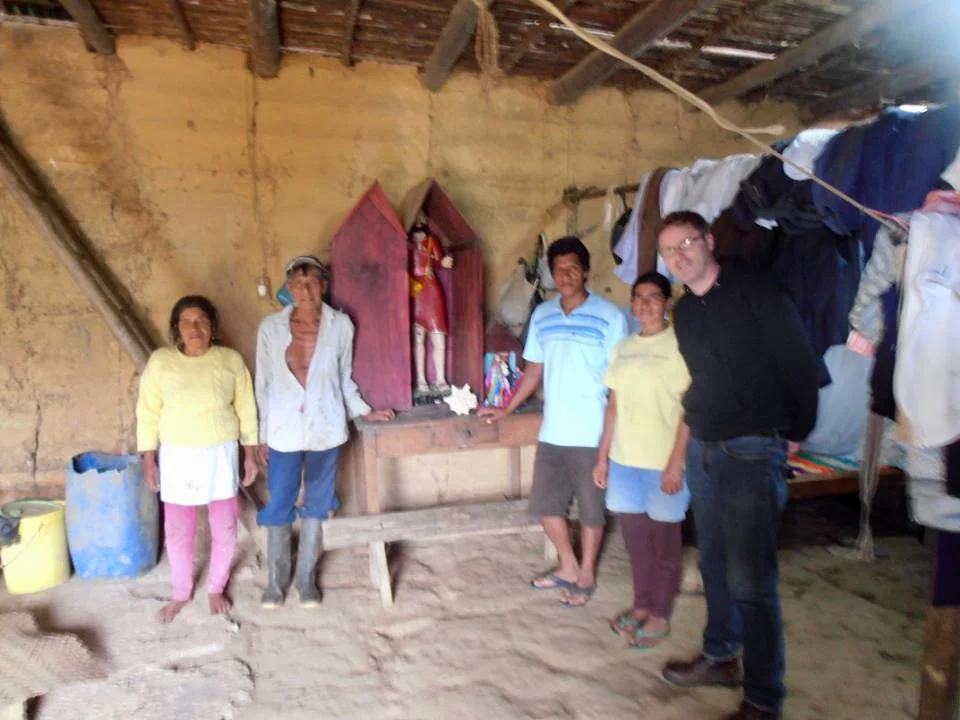
Next I travelled to Chiricyaku a two-hour walk from San Roque where I spent the night. Here I had the privilege of meeting Don Miguel Tapullima and his family. The Tapullimas are Quechua and have been guardians for over 150 years of a statue of San Roque brought from Spain by Father Sossimo Rivers a Catholic priest. Don Miguel introduced me to San Roque who lives in his own little house with a Quechua bag slung over his shoulder. Next to him is a smaller house was a statue of San Antonio adorned with traditional Quechua ribbons. I felt honoured to be in the Tapullima's and the saint’s presence.
After these excursions I started planning the icon design. In dialogue with local people it became clear the icon should celebrate the Quechua, their traditions, culture and spirituality. The saint would be Quechuan rather than a western representation. I also wanted to celebrate Quechua women and decided to include a female version of the saint in the icon.
As the design progressed I sought a local wood craftsman who could make the icon panel. On a guided trek further into the jungle I met Johnny Aubert. Originally from Lima, Johnny and his wife lived in San Antonio, a village about 15 minutes from where I was based. Through conversation Johnny shared he was a wood craftsman and had been regularly commissioned to create and build furniture, fittings and altars in churches. Looking at photographs I could see his work was beautiful. I told him about my project and he agreed to create the panel as well as a frame from local timber. He eventually settled on working with local cedar sourced from driftwood in the Rio Cumbaza.
Once the design was complete and the panel ready, I began painting using my own pigments and pigments I collected from the Huallaga Rio near the small town of Chazuta a two hour drive away from San Roque and the Rio Cumbaza near Sachaqa where I often swam. I also used achiote a dye made from a fruit which the Quechua men use to decorate their faces. Slowly the icon and the saints began to emerge. Progress was slow due to the heat, humidity and rain. Time was required for each layer of tempera to dry before the next colour could be applied. Insects were also a problem and indeed three days before I was due to depart Sachaqa cockroaches ate areas painted in indigo (a pigment made from plants) and strangely an arm of each saint which bore skin lesions. Thankfully the cockroaches were not interested in saints’ faces.

Collecting pigments from the Huallaga Rio
While at Sachaqa I also led a number of classes teaching visiting artist’s how to paint with egg tempera and natural pigments, as well as sharing the prayerful and spiritual discipline of icon painting. Dialogue with people from the local churches also continued. Plans were also formulated for the villager’s patronal festival in July where the icon would be carried through the village. The icon’s home in between festivals is in a beautifully crafted kiot (small sealed cupboard) made by Johnny, which would be placed in a little outdoor shrine designed by me in the grounds of Sachaqa allowing the icon to be a place of pilgrimage for people to visit and pray. The Directors of Sachaqa agreed to be the guardians of the icon.
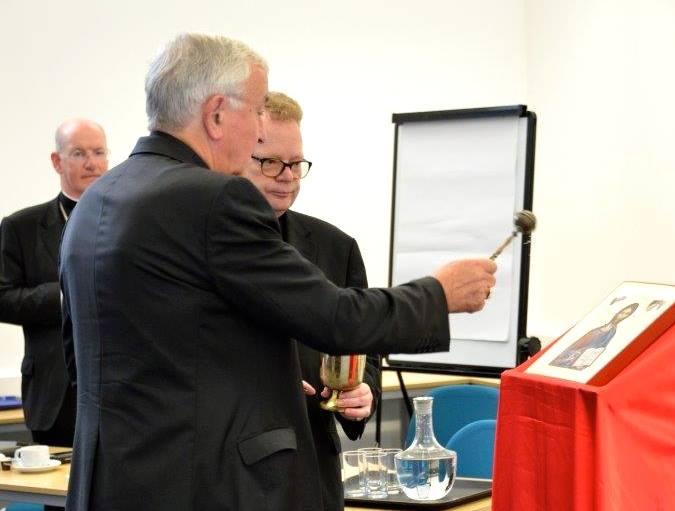
The icon was blessed with water from the Cumbaza. My prayer is for it to be a symbol of fellowship and unity and a beacon for pilgrims to pray and meditate before as they seek guidence and answers for their lives.
In the completed icon San Rocha’s gaze is direct while San Roque looks beyond, a reminder for the viewer and pilgrim to consider the wider world when praying. Both saints gently support symbols of nature, the colibri (hummingbird) a symbol for ancestors in the Quechua culture and an amazonian tree, a symbol for the gifts nature gives, as well as an important Quechuan symbol. On the saints arms are skin lesions as San Roque is invoked against the plague. Behind the saints the hills of the San Martin region where the Quechua live and high above them a star inspired by the Inca cross. The little dog in the frame is a reminder that the saint is patron saint of dogs and the Quechua step symbol around the frame symbolises continuity and everlasting life.

Nixon and Angel building the little house where San Roque will dwell.

Prints of this icon are available for sale here