All Saints Day was celebrated at St Saviours Church Pimlico in style! Students from my icon class displayed their work in front of the altar. The icons were blessed alongside the baptism of Hadrian Trafford-Roberts the grandson of Ros who presided over the service. I preached. The icon class has now been running for over 4 years. It began at St John on Bethnal Green and when I left there I moved it to St Saviours. As you can see from the photos the students have become quite accomplished!
Deep in this heart

Deep in this heart this heart of stone............
In the dream I sat up high at the top of a great tree beside me a beautiful black raven. The raven flew to the ground at the base of the tree and began to dig and scratch amongst the roots. I dropped down and joined in. As I dug, a hole began to emerge between the roots. The hole grew larger until I was able to crawl through a tunnel and then down into a large cave underneath the tree. It was a safe space a sacred place. I walked around touching the walls of this mysterious place. I felt something in the wall. It seemed to be a small rock but as I scratched away at the dirt it became bigger until eventually a huge boulder was revealed in the wall of the cave. “What is this?” I asked the raven. “It is your heart” the raven replied.


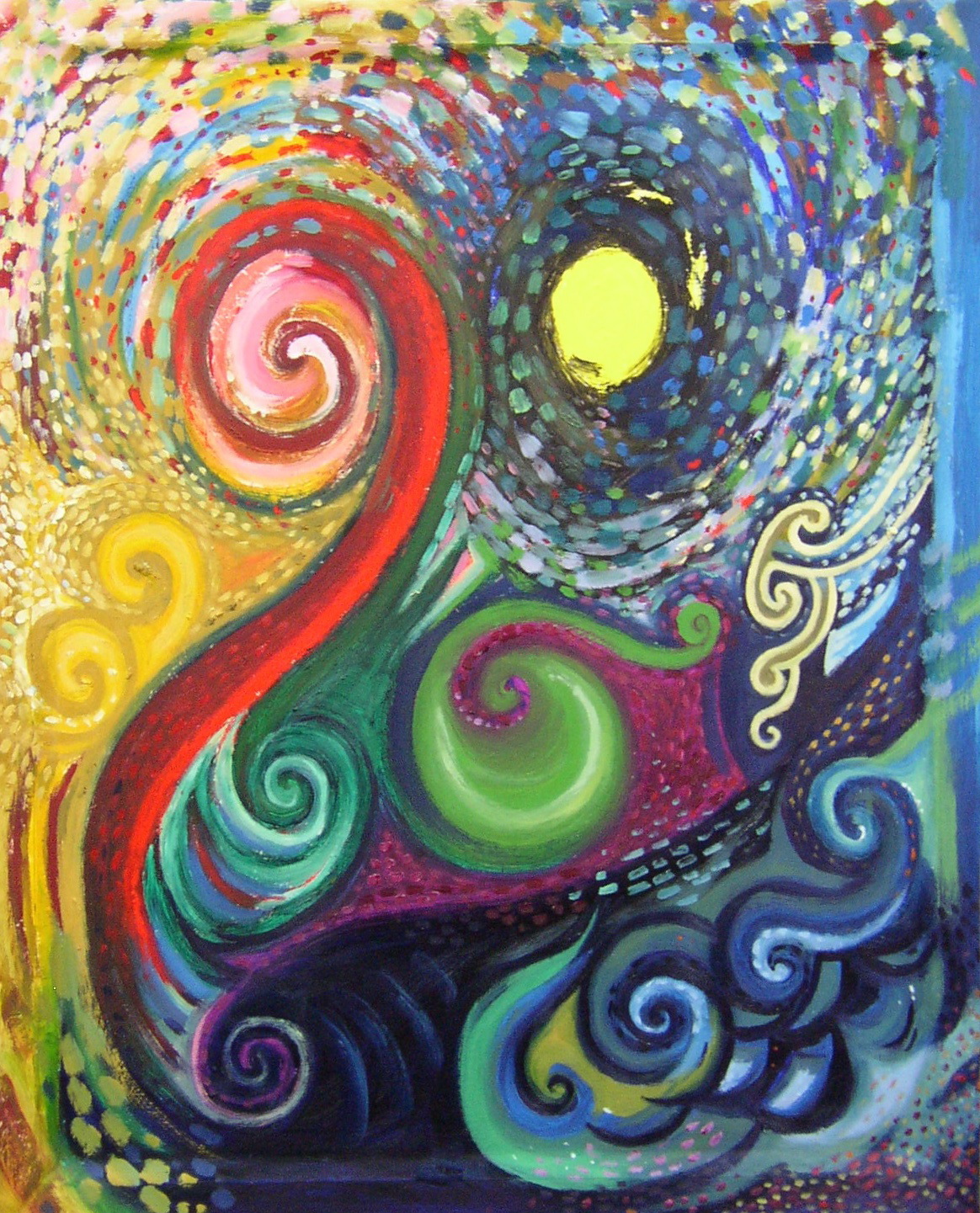
Savitri’s Spine, pastel, gold leaf on paper, 420 mm x 594 mm
Savitri and Satyavan
"The childless king of Madra, Ashwapati, lives ascetically for many years and offers oblations to Sun God Savitr. His consort is Malavi. He wishes to have a son for his lineage. Finally, pleased by the prayers, God Savitr appears to him and grants him a boon: he will soon have a daughter. The king is joyful at the prospect of a child. She is born and named Savitri in honor of the god. Savitri is born out of devotion and asceticism, traits she will herself practice. Savitri is so beautiful and pure, she intimidates all the men in the vicinity. When she reaches the age of marriage, no man asks for her hand, so her father tells her to find a husband on her own. She sets out on a pilgrimage for this purpose and finds Satyavan, the son of a blind king named Dyumatsena, who after he had lost everything including his sight, lives in exile as a forest-dweller. Savitri returns to find her father speaking with Sage Narada who announces that Savitri has made a bad choice: although perfect in every way, Satyavan is destined to die one year from that day. In response to her father's pleas to choose a more suitable husband, Savitri insists that she will choose her husband but once. After Narada announces his agreement with Savitri, Ashwapati acquiesces. Savitri and Satyavan are married, and she goes to live in the forest.
Satyavan's Visit, oil on gesso panel 650 mm x 800 mm
Immediately after the marriage, Savitri wears the clothing of a hermit and lives in perfect obedience and respect to her new parents-in-law and husband. Three days before the foreseen death of Satyavan, Savitri takes a vow of fasting and vigil. Her father-in-law tells her she has taken on too harsh of a regimen, but Savitri replies that she has taken an oath to perform these austerities, at which Dyumatsena offers his support. The morning of Satyavan's predicted death, Savitri asks for her father-in-law's permission to accompany her husband into the forest. Since she has never aksed for anything during the entire year she has spent at the hermitage, Dyumaysena grants her wish.
They go and while Satyavan is splitting wood, he suddenly becomes weak and lays his head in Savitri's lap. Yama himself, the Death, comes to claim the soul of Satyavan. Savitri follows Yama as he carries the soul away. When he tries to convince her to turn back, she offers successive formulas of wisdom. First she praises obedience to Dharma, then friendship with the strict, then Yama himself for his just rule, then Yama as King of Dharma, and finally noble conduct with no expectation of return. Impressed at each speech, Yama praises both the content and style of her words and offers any boon, except the life of Satyavan. She first asks for eyesight and restoration of the kingdom for her father-in-law, then a hundred sons for her father, and then a hundred sons for herself and Satyavan. The last wish creates a dilemma for Yama, as it would indirectly grant the life of Satyavan. However, impressed by Savitri's dedication and purity, he offers one more time for her to choose any boon, but this time omitting "except for the life of Satyavan". Savitri instantly asks for Satyavan to return to life. Yama grants life to Satyavan and blesses Savitri's life with eternal happiness. Satyavan awakens as though he has been in a deep sleep and returns to his parents along with his wife.

Dancing with Death oil on gesso panel
Meanwhile at their home, Dyumatsena regains his eyesight before Savitri and Satyavan return. Since Satyavan still does not know what happened, Savitri relays the story to her parents-in-law, husband, and the gathered ascetics. As they praise her, Dyumatsena's ministers arrive with news of the death of his usurper. Joyfully, the king and his entourage return to his kingdom."
The story of Savitri and Satyavan is found in "The Book of the Forest" of the Mahabharata. Article from Wikipedia 2010.
Titles of art work
Savitri's Spine
Satyavan's Visit
Dancing with Death
Mary Magdalene
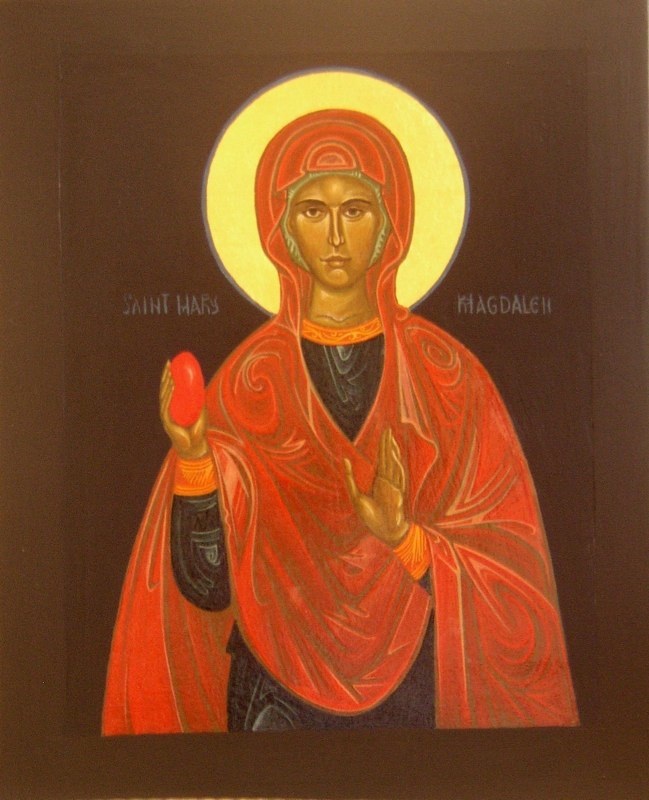
The story behind this icon is an interesting one. Mary Magdalene goes early in the morning to the tomb of Jesus. She arrives to discover the tomb empty and in shock drops a basket of eggs. Jesus appears to her and tells her to go back to the disciples to tell them he has risen from the dead. Mary gathers up her basket of eggs and runs to tell everyone the good news, but she is met with confusion and doubt. She recounts the story of finding the tomb empty and then meeting with Jesus who at first she didn't recognise. The Lord has risen it is a miracle. Mary holds up the eggs for the disciples to see.......they have all turned blood red!
This icon was exhibited at Wallspace Gallery in 2007 for the Epiphany exhibition a collection of contemporary icons. An orthodox nun who had beautiful icons also exhibited was rather sniffy about mine. She said it showed the absence of God because I had used black. This made me laugh as I hadn't used black but indigo for the background. (I wouldn't have a problem with using black either). Still even with this criticism my icon was the first to sell!
For me writing icons is an act of prayer and encouragement.
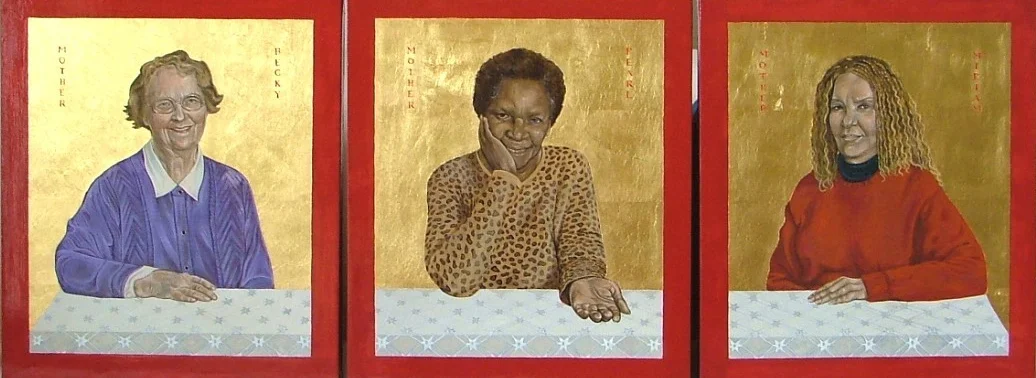
Regan O'Callaghan 3 mothers, religious icon, sainthood of all believers, gold leaf, Bishop of London, liturgical colours
3 Mothers - Icon of Hospitality
This triptych commissioned by the Bishop of London, depicts three smiling women from the congregation of St John on Bethnal Green Church, seated around a table.
The women reflect the diverse nature of the congregation at St John's as well as the local East End community.
Each woman is a wife, mother, and grandmother, a person of faith and a committed hard working member of their church, something I wanted to celebrate. The three women also symbolise in part the important role of women – particularly older women – in the Church of England.
The opened hand of Mother Pearl is held out to greet the viewer to the table, a place of fellowship and hospitality while Mother Becky and Mother Miriam look on. What offering do you the viewer bring to the table? The stars on the table cloth symbolise the many descendants of Abraham. The colours the three women wear represent the Christian liturgical seasons and the gold leaf a belief in the 'sainthood of all believers.'